Palworld spent its first years as one game with one answer to a simple question: what happens when you cross creature collecting with open-world survival and hand everyone a rifle. That era is over. The franchise now has two officially licensed mobile games in development at two different companies, built on two different philosophies, and a meaningful slice of the community still believes they are the same project wearing different logos. They are not. Krafton's Palworld Mobile and Garena's Palworld Online are separate games, separately licensed, separately developed, and aimed at different kinds of players. Telling them apart is easy once you see the shape of each one. The harder question, the one fans keep circling back to, is what happens now that one of those games appears to be showing off a creature the main game has never named.
Two licenses, two games, zero overlap#
Start with the thing most headlines get wrong. Palworld Mobile and Palworld Online are not regional names for one app, not a soft launch and a global launch of the same build, and not two modes of a single client. They are two distinct commercial projects, each carrying its own official license from Pocketpair, each built by a studio with its own track record and its own idea of what Palworld on a phone should be.
The cleanest way to hold the distinction in your head: Krafton's title is a mobile reinterpretation of the original survival-crafting experience, rebuilt around shooter combat and cooperative content designed for touch screens. Garena's title is an MMORPG, built around a persistent shared world, social structures, and an original narrative layer that the main game does not have.
| Palworld Mobile | Palworld Online | |
|---|---|---|
| Developer | PUBG Studios, under Krafton | Garena |
| What it is | Mobile reinterpretation of the survival-crafting original | Officially licensed Palworld MMORPG |
| License and reveal | Global license secured from Pocketpair in 2024 | Announced August 3, 2026 |
| Announced milestone | First closed alpha announced for Korea and Japan in December 2025 | Planned availability in 2026, exact timing to be announced |
| Core loop | Field exploration, survival, crafting, shooter combat strengthened for mobile | Collecting and raising Pals inside a seamless, interconnected open world |
| Multiplayer shape | Mobile-focused co-op, including a plaza and boss raids | Groups, shared settlements, base visits, shared crafting and defense, PvE and PvP |
| Story | Palworld's survival premise, translated to mobile | A new narrative setting with original story elements and exclusive side stories |
| Platforms | Mobile | Mobile |
Everything else in this article hangs off that table. The two games share DNA, and that shared DNA is exactly why the internet keeps blurring them together.
How Krafton ended up holding Palworld's mobile future#
Krafton moved first, and it moved early. Back in 2024, while Pocketpair was still deep in early access and years away from the milestone we covered in everything added in Palworld 1.0, Krafton secured a global license to build a mobile Palworld game, with development assigned to PUBG Studios. The company laid this out on its own official licensing announcement, which is worth understanding for what it signals rather than just what it says.
Handing the project to PUBG Studios was not a neutral choice. The studio's identity is tied to gunplay and survival tension, which made Krafton's direction legible before the feature list arrived. If you wanted a one-sentence prediction of what Palworld Mobile would become, the studio assignment already made it: this was always going to be the version that takes the gun half of Palworld's identity seriously.
That is also why the 2024 license aged well. Krafton did not rush a port out the door to ride the launch hype. It sat on the license for over a year, built, and only started talking specifics when it had systems to describe.
Inside Palworld Mobile: the survival game, rebuilt for touch#
Those specifics arrived on November 13, 2025, when Krafton published an update confirming that the first closed alpha test would run in Korea and Japan in December 2025. The official alpha announcement is the single most detailed public document about what this game actually is, and it describes something more interesting than a shrunken port.
The foundation is intact. Field exploration, survival and crafting, Pal raising, open-world survival, and building all carry over. Anyone who has internalized the base game's rhythms, the loops documented across the PalMods Palworld guides, will recognize the skeleton immediately. What changes is the musculature around it.
The Player Pal Skill system#
The standout system is the one with the clumsiest name. The Player Pal Skill system uses Pals strategically as skills, which reads like a small UI decision and is actually a philosophical one. In the main game, Pals are companions with their own battlefield behavior. Krafton's description places them directly inside the player's combat options, turning Pal choice into part of the mobile action kit. Whether that still feels like Palworld, or like a shooter that happens to have Pals in its ability slots, is one of the central design questions this adaptation has to answer.
Co-op built around focused activities#
The multiplayer design tells the same story of deliberate adaptation. Krafton describes mobile-focused cooperative content: a plaza where players gather and boss raids they tackle together. Its public pitch centers on distinct social and combat activities. Garena's announcement, by contrast, centers the shared world itself.
Inside Palworld Online: Garena builds the persistent world#
On August 3, 2026, Garena announced Palworld Online, an officially licensed Palworld MMORPG for mobile, developed and published by Garena itself, with planned availability in 2026 and exact timing still to be announced. Within hours, the community thread on r/Palworld filled with the two questions this article exists to settle: is this the Krafton game, and what is that creature in the artwork.
It is not the Krafton game, and the feature list makes the difference unmistakable. Garena confirmed a seamless, interconnected open world. On top of that world sits a social architecture the main game has never attempted at this scale: group formation, shared settlements, base visits between players, shared crafting, and shared defense. Pal automation carries over, but now the base those systems maintain is also a social object that other people can visit.
The combat and progression layer is classic large-scale online design: open-world bosses, rare Pals to chase, and both PvE and PvP. And crucially, Garena confirmed a new narrative setting with original story elements, unique lore, and exclusive side stories. This is not the Palpagos Islands retold. It is a new corner of the universe with its own fiction.
The delivery details matter too. Touch-friendly UI, optional one-tap controls, and support across a broad range of phone specifications fit Garena's established strengths in global publishing, localization, and live operations. Pocketpair is the licensor, not the developer, and reading Palworld Online as a Pocketpair production misunderstands what this deal is. Garena is building its own game inside Pocketpair's universe.
Krafton is translating Palworld to the phone. Garena is expanding the world Palworld happens in.
Why everyone keeps mixing them up#
The confusion is not stupidity. It is a predictable collision of four factors, and it would fool anyone skimming a feed.
First, both games are official. There is no knockoff to dismiss, so the usual mental filter of "one real, one fake" fails. Second, both preserve the same recognizable DNA: collecting, building, and combat with creatures underfoot. A thirty-second clip of either game reads as "Palworld on a phone." Third, the English names are nearly interchangeable. "Palworld Mobile" and "Palworld Online" are the two most generic possible labels for the same elevator pitch, and casual coverage swaps them freely. Fourth, and most corrosive, announcements travel as cropped key art and screenshot reposts that strip out the developer credit, which is the single detail that would resolve the ambiguity instantly.
The distinction will only get more important as both projects move toward release. Two official mobile games developing in parallel, covered by posts that already conflate them, create a real risk that players will expect one game's promises from the other.
The creature in the key art#
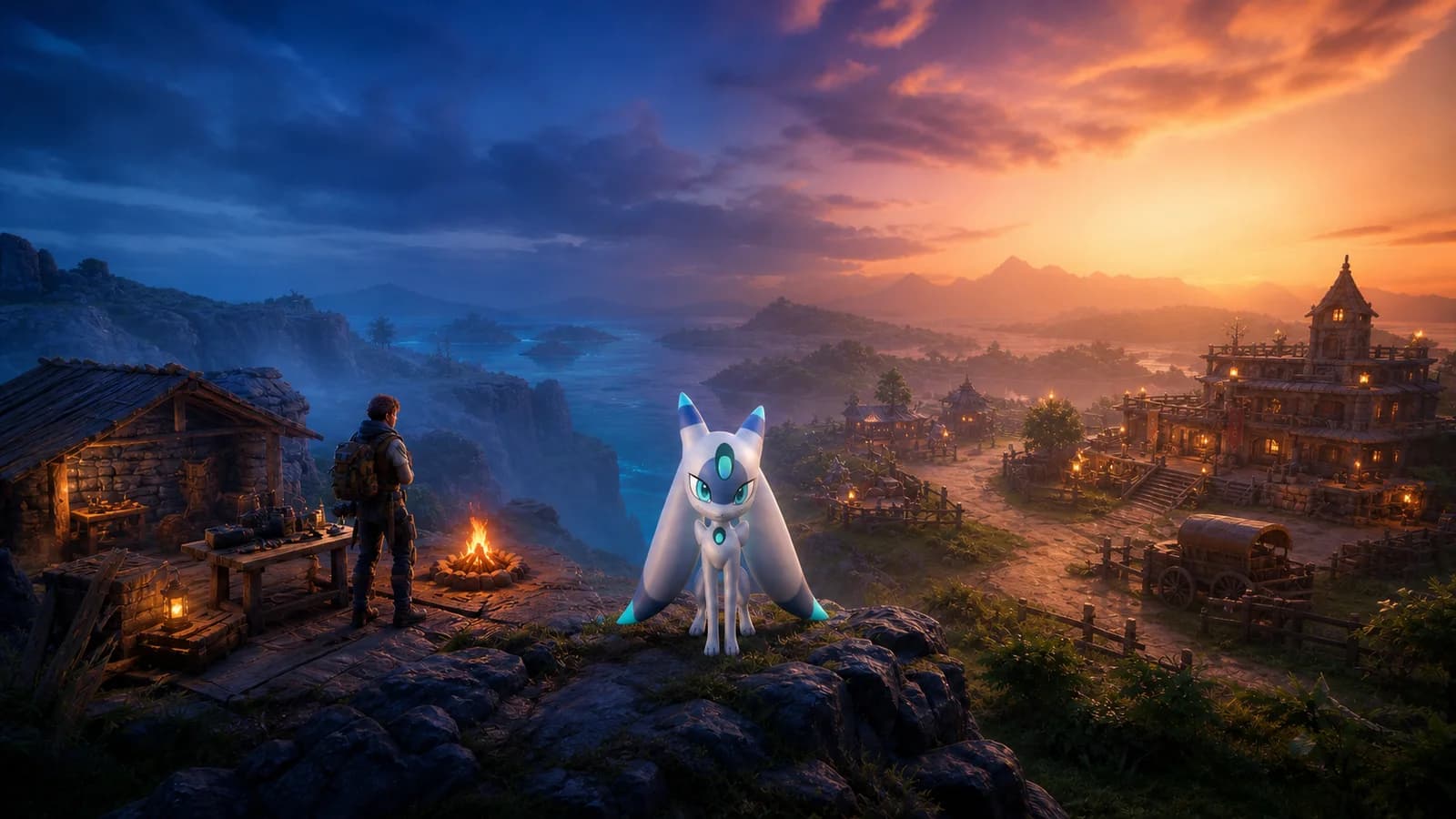
Which brings us to the question that has generated more discussion than either game's feature list. Fans dissecting the Palworld Online announcement art believe one of the creatures shown may be entirely new, and that its design may resemble or relate to Lunaris. The thread reads like a courtroom: side-by-side crops, silhouette comparisons, arguments about ear shape and color language.
Here is the boundary, stated once: Garena has not identified that creature. It is not confirmed as a new Pal, a Lunaris relative, or a future main-game addition.
What makes the speculation worth taking seriously anyway is the structural position it occupies. Garena has explicitly promised unique lore and exclusive side stories, and an MMORPG built around chasing rare Pals has every design incentive to hold creatures the main game does not have. An unfamiliar silhouette in the first piece of key art is exactly what you would expect from a game whose entire pitch is "a new corner of the universe." The community is not reacting to a smudge in a screenshot. It is reacting to the first plausible case of a Palworld creature debuting outside Pocketpair's own game, and it understands, correctly, that how the franchise handles that first case will set the template for every case after it.
A creature that exists in only one game is a curiosity. A creature that travels between games is canon.
Exclusive forever, exclusive for now, or shared back#
So treat it as a policy question, because that is what it is. If a spin-off introduces a creature, there are only three things the franchise can do with it, and each one shapes how the universe feels.
The case for permanent exclusivity#
Permanent exclusives are the bluntest instrument and the easiest to justify commercially. If Palworld Online holds creatures nobody else has, that is a durable reason to install it, and for a live-service game, durable reasons matter more than launch spikes. There is even a design argument: an MMORPG's rare-Pal chase economy works better when its rarest prizes cannot be obtained by playing something else. But permanence has a cost that compounds. Every permanently locked creature is a small message to main-game players that the full Paldeck now lives across multiple storefronts, and the collection instinct that powers this genre curdles fast when completion becomes structurally impossible in the game you actually play.
The case for temporary exclusivity#
Temporary exclusivity is the compromise that respects both sides of the ledger. The spin-off gets a genuine debut: months where its creature is the reason to log in, its lore the only place to learn the story. Then the creature graduates to the main game, arriving with history instead of a bare stat block. The spin-off keeps a permanent distinction, being the place the creature came from, without holding the collection hostage forever.
The case for immediate sharing#
Simultaneous availability treats the franchise as one continuous world, which is the most generous reading of what a shared universe means. Its weakness is that it erases the debut. If everything appears everywhere at once, the spin-offs are reduced to alternate interfaces, and neither Krafton nor Garena signed licensing deals to build alternate interfaces.
The honest reading of the incentives says temporary exclusivity is the only option that ages well. It is the only model where the spin-off gets its moment, the main game keeps its promise of completeness, and the player is never told that the creature they want lives permanently in a game they do not enjoy.
One universe or three canons#
Creatures are only half the canon question. The other half is story, and the two halves should be answered differently.
Creature canon wants to be shared. Pals are the franchise's alphabet: the same recognizable beings appearing across games is what makes Palworld feel like a universe rather than a brand license. When a creature crosses from one game to another, both games gain weight. The spin-off becomes a real place where real things originate, and the main game becomes the gravitational center that everything eventually orbits. A shared bestiary is the cheapest, most legible form of connective tissue a franchise can have.
Story canon wants to be separate, and Garena's announcement already points this way. A new narrative setting with original story elements is a firewall as much as a feature: it lets Garena kill characters, break regions, and take tonal swings that a shared timeline would forbid, and it protects Pocketpair from ever inheriting a plot development it did not write. The alternative, one master timeline spanning a survival game, a mobile shooter, and an MMORPG run as a live service by three companies on three schedules, is how franchises end up retconning themselves into paste.
The synthesis is straightforward: share the beings, separate the events. Lunaris is Lunaris wherever it appears. What happened in some settlement in Palworld Online stays in Palworld Online unless Pocketpair deliberately imports it. Connected fauna, independent fiction. That is the configuration where the universe feels whole without any single game holding the others hostage.
A player-first framework for cross-game creatures#
If Pocketpair, Krafton, and Garena want the version of this future that players actually thank them for, the policy fits in five lines:
- Debut windows, not vaults. A spin-off creature launches exclusive for a defined period, long enough to matter, never forever.
- A crossover path home. After the window, the creature reaches the main game through a crossover quest or update that acknowledges where it came from.
- Exclusivity labeled at announcement. Every reveal states up front whether the creature is temporary, permanent, or shared, so nobody buys a promise that was never made.
- Cosmetics cross, power does not. Cross-promotion between games trades in skins and flair, never in stat advantages that make one game homework for another.
- No required reading. The main game's story must stand alone. Spin-off lore enriches; it is never a prerequisite.
Five rules, one principle: reward the players who show up everywhere, and never punish the ones who do not.
The stakes for the game you already play#
It is tempting to file all of this under "mobile news" and go back to base building, but the main game does not get to sit this out. Palworld's identity has so far been defined by one studio's voice. Within the next year, most new players' first contact with the franchise may come through a phone, through Krafton's shooter-forward translation or Garena's social world, and the creatures and stories they meet there will be what "Palworld" means to them. The center of gravity of a franchise is wherever its audience actually lives.
That is why the two mobile games are not a sideshow but a stress test of the thesis this article opened with. The franchise now has two very different answers to how Palworld should work on a phone: one that compresses the original experience into your hands, and one that stretches it across a persistent world full of other people. Both can succeed. What decides whether Palworld becomes a coherent universe or a loose federation of licensed products is the connective tissue: whether creatures travel, whether stories acknowledge each other, and whether the companies involved treat players as one audience or three markets.
So here is the debate worth having in the comments. If that unfamiliar creature in Garena's key art turns out to be exactly what fans think it is, what should happen to it: locked to Palworld Online forever as its signature prize, given a debut window before crossing to the main game, or shared everywhere from day one? And would your answer change if the next new Pal debuted in Krafton's game instead? Make the case. The precedent is being set right now, and the loudest, clearest argument might actually reach the people setting it.
Comments
Loading discussion...