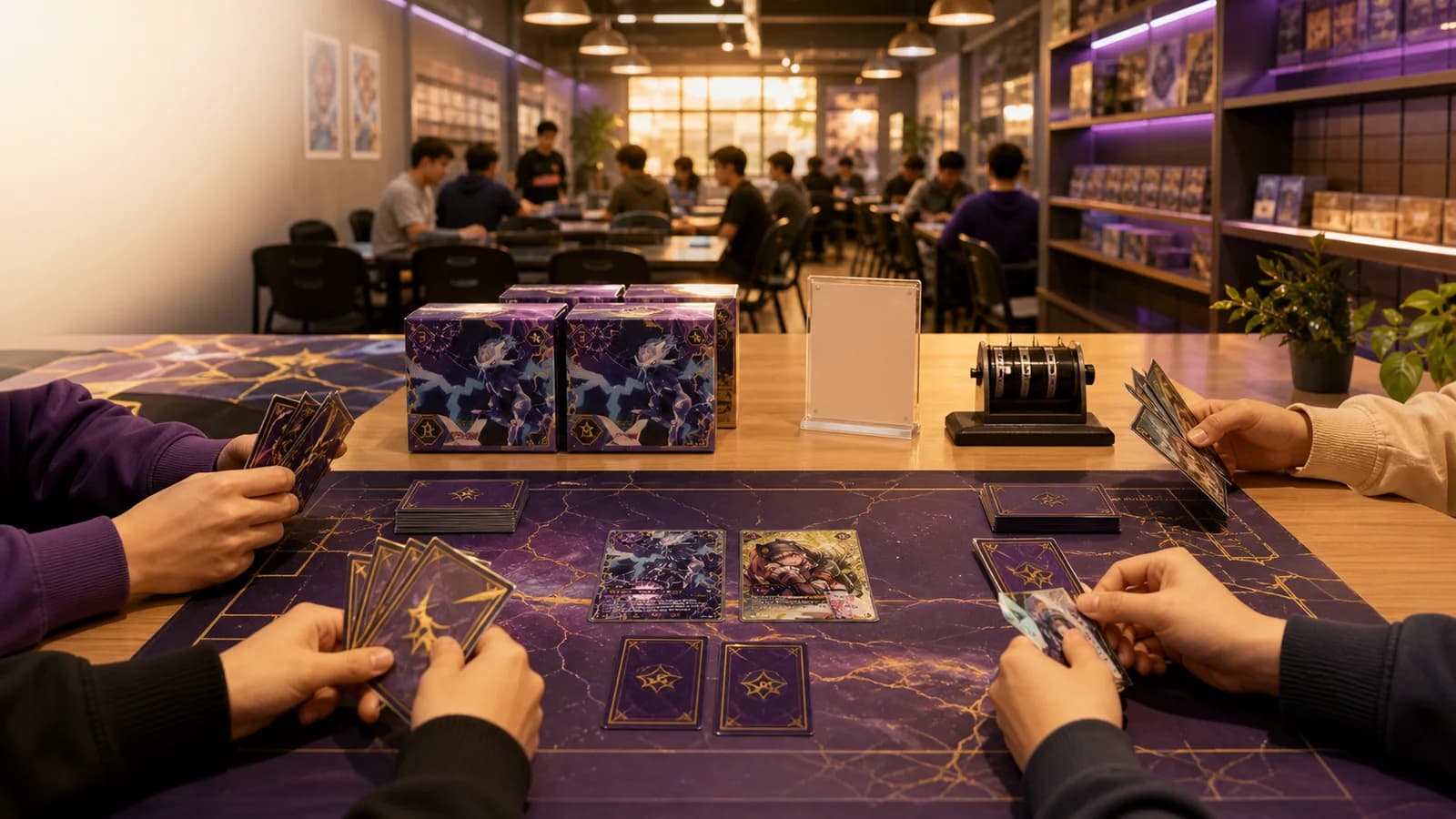
The Palworld Trading Card Game did the one thing no new card game can afford to do: it succeeded too hard, too fast, in the one dimension that does not matter. BP01 Dawn of Palpagos, the game's first booster set, hit shelves on July 30, 2026 and promptly vanished from them. Two weeks later, the official Japanese account was apologizing to fans who could not find a single pack. A sellout looks like a triumph on a spreadsheet. On the floor of a local game store, it looks like an empty display case, a disappointed kid, and a league night that never forms. The publisher has said countermeasures are being considered, but it has not announced a reprint or restock date. The question is what a player-first response would actually look like.
A Sellout Is Not a Success Story#
Let's establish the facts before the argument, because the facts are unusually clean here.
BP01 Dawn of Palpagos is listed on the official product page with a release date of July 30, 2026. It is the foundation set: the card pool that starters point into, the packs that new players are told to buy, the raw material for every deck that will show up at an official event this year.
Within the first wave of release, availability collapsed. Shelves emptied, restocks evaporated, and resale listings climbed to multiples of retail. By mid August the situation was bad enough that the publisher said so publicly.
On August 12, 2026, the official Japanese Palworld OCG account posted an acknowledgment that product remained in short supply. It apologized that fans who were looking forward to the game could not obtain it, said that countermeasures were being considered internally so that products could reach more people, and promised another update soon.
#パルワールドカードゲーム 【ブースターパック第1弾「パルパゴスの夜明け」につきまして】 現在品薄の状況が続いており、楽しみにしてくださっている皆さまに商品を手に取っていただけない状況となっておりますこと、心よりお詫び申し上げます。 現在、より多くの皆さまに商品をお届けできるよう、社内にて対応策を検討しております。 今後の対応につきましては、近日中に改めてご案内いたします。 お待ちいただいている皆さまには大変申し訳ございませんが、今しばらくお待ちくださいますようお願いいたします。 今後とも『パルワールド オフィシャルカードゲーム』をよろしくお願いいたします。
That statement deserves credit for existing. Plenty of publishers let a shortage ride for months without a word. But it is also worth being precise about what it committed to.
So we are in the gap between acknowledgment and action. That gap is exactly the right time to talk about what action should look like, because once an allocation scheme ships, it is very hard to change.
The Shortage, the Symptom, and the Fix#
Shortages get discussed as one undifferentiated crisis, which makes them impossible to solve. It is more useful to split the situation into distinct problems, each with its own visible symptom and its own player-first response.
| Shortage problem | Visible symptom | Player-first response |
|---|---|---|
| First print sized below real demand | Empty shelves within days, stores with no restock date to give | A reprint wave sized to restore deck building, not to sell out again |
| Resale arbitrage on scarce sealed product | Marked-up listings stacking on secondary marketplaces | Purchase limits in the first restock wave, opened-box options for stores |
| Opaque store allocation | Some stores got cases, others got almost nothing, nobody knows why | Published allocation criteria that weigh organized play without starving new stores |
| No public timeline | Interested players giving up before they start | Clear dates and regular status updates, even when the news is "not yet" |
| Uneven regional supply | One market saturated while another waits indefinitely | Regional distribution commitments announced alongside quantities |
Notice that only one of those five rows is about printing more cards. The other four are about how cards move from a printer to a player's hands. A reprint that fixes the first row and ignores the rest will produce a second sellout with better volume numbers and the same empty shelves.
Scalpers Versus Demand Is the Wrong Fight#
Spend ten minutes in the community and you will find the argument already raging. A thread on r/PalworldTCG captures the mood: players who wanted in, found nothing at retail, found plenty at triple the price, and concluded the game was never really for them.
One camp blames scalpers, pointing at the volume of marked-up listings as proof that bots and flippers hoovered up the supply. The other camp argues that Palworld is one of the biggest game franchises of the decade, that genuine demand simply crushed a conservative first print, and that resellers are a symptom rather than a cause.
Here is the uncomfortable truth: both camps are describing the same machine from different sides, and neither can prove its share of the blame. Nobody outside the publisher knows the print run. Nobody can measure what fraction of boxes went to speculation versus play. Anyone quoting a percentage is inventing it.
What we can say with confidence is this. Scalping is not an independent force of nature. It is a parasite on a specific host condition: supply visibly below demand with no credible restock signal. When a publisher announces large, dated, repeated reprint waves, the speculative case for hoarding sealed product collapses, because the resale price depends entirely on scarcity persisting. Resellers did not create the shortage, but the shortage created them, and only supply policy can starve them.
High resale prices are evidence that access failed. They are not, by themselves, proof of who caused every empty shelf, and a reprint plan built on blaming one villain will misfire.
The practical conclusion: treat scarcity and speculation as overlapping forces and design the reprint to defeat both at once. Volume defeats the speculator's thesis. Distribution rules defeat the speculator's method. You need both, and arguing about which villain deserves more blame delays both.
The Calendar Is Not Waiting#
If this were a slow-burn game with no near-term commitments, the publisher could take a quarter to sort out supply. It is not, and it cannot.
BP02 arrives in October#
The product page already lists BP02 Legends Awaken for October 30, 2026. To be clear, that is not a prediction that BP02 will face the same shortage; a second set is exactly where a publisher applies the demand data it just collected. But it does mean the window for restoring confidence in BP01 supply is measured in weeks. If players cannot get the foundation set before the second set lands, the game develops a two-tier population: those who got in during week one, and everyone else, permanently a set behind.
Organized play is already rolling#
The bigger pressure is competitive. The official organized play announcement lays out an ambitious calendar: official shop tournaments starting in August 2026 with quarterly promo cards, Challengers Cup events planned from September through November 2026, and a Masters League running across more than 20 regions from September 2026 through March 2027, all funneling toward Masters World Finals in Tokyo in May 2027.
That is a serious, well-structured competitive pyramid. It is also a pyramid built on a foundation that players currently cannot buy. A shop tournament in September needs players with decks in September. A Masters League spanning 20 regions needs 20 regions with functioning supply. The organized play calendar is, in effect, a series of deadlines the reprint has to hit.
This is the core risk in one sentence: a card game cannot grow local tournaments if interested players cannot acquire enough cards to build and revise decks through normal retail channels. Everything else is downstream of that.
Four People a Reprint Has to Serve#
Before writing a plan, define success. A player-first reprint is one that works for four different people at once, because a healthy local scene needs all four in the same room.
The curious newcomer#
Someone who watched Palworld content, wandered into a store, and wants a starting point. They need a starter path they can buy today at retail price, and a clear next step after it. Our Palworld Official Card Game launch guide exists precisely for this person, and right now it describes products they cannot buy. That is the shortage in miniature.
The active player#
Someone past the starter stage who wants to build a real deck and then change it. This is the person shortages quietly destroy, because deck building is not a one-time purchase. You buy packs, you trade, you fill gaps, you adjust after losing on league night. Access has to be repeated and reliable, not a single lucky restock.
The local store#
The store needs enough stock to sell, enough to run events, and enough predictability to schedule a league without gambling on a shipment. Stores are the physical substrate of a TCG community. A game that starves them is eating its own foundation.
The collector#
Collectors are not the enemy of players; speculators are. A collector needs to understand what a reprint means for their collection: which printings exist, how to tell them apart, and whether anything they own is affected. What a collector must never get is gameplay exclusivity, in either direction.
A Seven-Part Player-First Reprint Plan#
Here is what a reprint built for those four people would look like. None of this is announced policy. It is a standard to hold the eventual announcement against.
1. Print to restore deck building, not to sell out again#
The headline decision is volume, and the target should be stated honestly: enough supply that a player can walk into a store weeks after the wave lands and still buy product. A reprint sized to produce a second flash sellout is a marketing event, not a fix. The publisher has demand data now that it did not have in June. The right print run is the one that makes hoarding pointless, and it will feel uncomfortably large to whoever signs off on it. That discomfort is the point.
2. Per-customer limits during the first restock wave#
For the first wave only, cap purchases per customer and per household at a level that supports real play, then publish the cap so players know it before they drive to the store. Limits are a blunt tool with real costs, covered below, but in the opening days of a restock they buy time for distribution to outrun speculation. They should also be explicitly temporary, with a stated condition for removal: when product stays on shelves for a defined stretch, the caps die.
3. Preorder queues with transparent fulfillment order#
Let players and stores join a preorder queue and see, honestly, where they stand. First come, first served, with visible position and honest quantity commitments behind it. A queue with no visibility is just a lottery with extra steps, and a queue backed by fantasy quantities is worse than no queue at all. But a real one converts panic into patience, because the difference between "I will get a box in November" and "I may never get a box" is the difference between a player who waits and a player who leaves.
4. Store allocations that reward organized play without starving newcomer stores#
Allocation formulas should weigh whether a store actually runs events, reports league attendance, and moves product to players. That rewards the stores doing the community work. But the formula needs a floor: a store that just signed up to carry the game has no organized play history by definition, and if history is the only input, the game can never expand its retail footprint. Reserve a meaningful slice of every wave for new accounts, and say so publicly.
5. Opened-box and cut-seal options for stores that want them#
Give stores the explicit blessing, and the margin structure, to open sealed product and sell packs individually, run pack-per-entry events, and stock singles. A sealed case in a display cabinet can become resale inventory. An opened case becomes forty individual chances for a player to buy in at retail. This should be optional, because it is genuinely wrong for some stores' business models, but the stores that want to route product directly into players' hands should never be penalized for it.
6. Reserved league stock and learn-to-play pools#
Carve out a protected slice of the reprint that never touches the shelf: prize support for the shop tournaments already starting, and loaner or teaching decks for learn-to-play nights. The organized play calendar from the official announcement only works if the events themselves are supplied independently of retail chaos. A league night should never be cancelled because the shelf sold out, and a curious newcomer should be able to play a teaching game with borrowed cards before spending anything.
7. Public dates, regional fairness, and no exclusive chase cards#
Announce dates, then hit them, then update publicly when anything slips. Commit to supplying regions in parallel rather than saturating one market while another waits, because a global franchise that supplies one territory and abandons another is teaching the abandoned territory to stop caring. And resist the temptation to spice the reprint with exclusive new cards: the moment a reprint wave contains gameplay content the first wave lacked, existing players are forced back into the scramble, and the reprint has manufactured the exact shortage dynamic it was meant to end.
The right reprint makes hoarding pointless, makes waiting tolerable, and makes the shelf boring again. Boring shelves are what healthy card games look like.
Every Fix Has a Cost#
An honest plan admits its own failure modes, so let's stress-test the proposals rather than pretend they are free.
Purchase limits create administrative burden and can be bypassed. Enforcement lands on store staff, and determined buyers recruit friends, revisit, or split across households. Limits are worth it early precisely because they slow speculation during the highest-pressure days, but they are friction, not a wall, and they should expire on schedule rather than calcify into permanent policy.
Opened-box policies are not right for every store. Some stores lack the staffing for singles inventory, some rely on sealed sales to make thin margins work, and cracking cases exposes them to variance risk. The proposal is an option with support behind it, never a mandate.
Organizer-weighted allocations can entrench incumbents. A formula that only rewards existing event history builds a moat around the stores that happened to get BP01 stock, which is why the newcomer floor in part four is not a nice-to-have. Without it, the allocation system quietly decides the game will never open new stores.
Preorders are only as good as the honesty behind them. A transparent queue against real quantities is a trust machine. The same queue against inflated quantities is a trust shredder that will do more long-term damage than the original shortage.
Your Local Store Is Not the Villain#
One more correction to the community conversation, because it matters for what happens next: the store employee telling you there are no packs did not cause this.
Player and store reports describe small BP01 allocations, including stores that received a fraction of what they requested. Staff have spent the launch absorbing frustration over a supply decision made far upstream of them, and some of the anger landing on counters belongs in an email to a distributor instead. If the shortage turns players against stores, the game loses the exact venues its entire organized play pyramid depends on.
That said, stores are not powerless, and the good ones are already acting like it. Scarce stock can be distributed fairly or badly, and the difference is policy, not luck.
A checklist for stores and organizers, starting now#
- Publish your restock policy before product arrives: limits, holds, and how you will announce drops, so nobody has to guess or camp.
- Set per-customer limits on scarce stock yourself, and post them at the counter. You do not need to wait for anyone upstream to permit fairness.
- Prioritize your league players and event regulars for scarce allocations, visibly, so buying into the community has value that flipping does not.
- Crack a box for singles and pack-per-entry events if your model supports it, so a player with twenty dollars has something to buy.
- Run learn-to-play nights with teaching decks now, even while product is scarce. Demand does not evaporate during a shortage, but it does wander off to other games if nothing is happening.
- Keep a waitlist with names and take it seriously. A store that calls a player when stock lands has earned a regular.
- Report your event attendance through official channels once shop tournaments begin, because if allocations end up weighing organized play, your league nights become your supply argument.
- Talk to your players honestly about what you were allocated. Opacity upstream is not a reason to be opaque downstream.
None of this requires publisher action. All of it makes the store a place players trust while the supply question gets resolved, and trust is the only currency that survives a shortage.
The Test That Matters#
Here is the standard, stated as plainly as possible.
The reprint will be judged a success in headlines if it sells out. It should be judged a success by exactly one measure: whether an ordinary player, with no connections, no bot, no alert group, and no willingness to pay resale prices, can walk into a local store several weeks after the wave lands, buy a viable path into the game, and come back for a shop tournament with a deck they built and can afford to revise. Not day one. Weeks later. Boringly, reliably, at retail.
Every proposal in this article rolls up to that test. Volume makes it possible. Limits and queues protect it early. Allocation floors extend it to new stores. League stock guarantees the events exist when the player shows up. Transparency keeps them waiting instead of leaving. And the calendar gives it a deadline, because Challengers Cup events start in September, Masters League runs through March 2027, and BP02 lands on October 30 whether the foundation set is buyable or not.
The publisher's August 12 statement says countermeasures are coming, and there is every reason to hope they land well. Palworld's card game has the license, the event pyramid, and visibly overwhelming demand: the three things most new TCGs would trade anything for. The only thing between it and a genuinely great local scene is cardboard reaching hands.
While we wait for the update, we are tracking the format, the card pool, and the competitive calendar over at the PalMods TCG hub. So put your position on the record: if you were designing this reprint, would you accept slower shelves, purchase limits, and preorder queues to guarantee everyone a seat at the table, or should the publisher just print a mountain and let the market sort itself out? One of those answers builds a community. Tell us which one, and defend it.


Comments
Loading discussion...