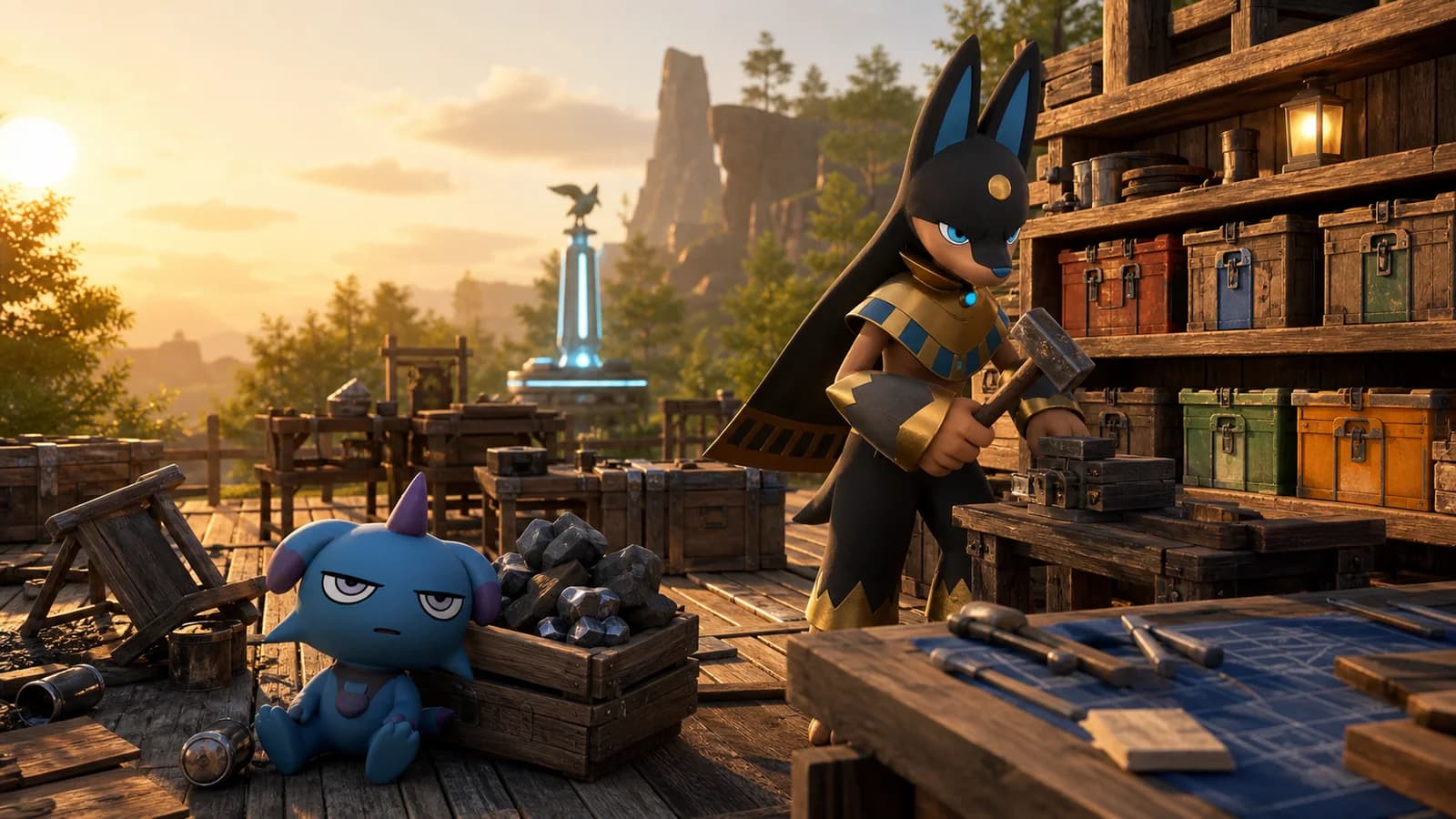
When Pocketpair's publishing lead opened the floor for Palworld 1.1 suggestions, he probably expected a wish list. What he got was closer to a group therapy session: seventeen hundred comments, and the most revealing requests were not asking for new islands or a raised level cap. They were asking for a Pal that remembers its job. For a chest that sorts itself. For a bed that stays assigned and a cursor that stays on screen. Across the wider community debate, players repeatedly asked Pocketpair to fix the things it already built. That should be read as a compliment, and as a roadmap.
This is the case for that roadmap: why a deliberately smaller 1.1 could land harder than the enormous 1.0 that preceded it, which fixes deserve the top of the queue, and what a great version of this update would actually feel like in your hands.
The Tweet That Reset Expectations#
After Palworld 1.0 shipped, Bucky, Pocketpair's publishing lead and community manager, did the thing community managers are always told to do and rarely enjoy doing: he asked players what they wanted next. The replies arrived by the hundreds, and a meaningful chunk of them reached for scale. New continent. Twenty more levels. Another year-long mega update.
On August 13, he drew a line under that thinking.
Shot myself in the foot here, 1.7k comments later, but things like "add a new continent", "add 20 more levels" and similarly massive undertakings are not really what we want to do with v1.1. Open to ideas but, we're not planning to spend a year making a massive update for 1.1.
Some corners of the internet read this as a retreat. It is the opposite. It is a studio correctly identifying what kind of update the game needs, and one of the clearest community responses is a thread arguing the next update has to focus on quality of life and consistency, not another content avalanche. Palworld 1.0 already was the content avalanche. It rebuilt base construction, expanded the endgame, and reshaped how the game plays hour to hour. Following it with a second avalanche would bury the first one before players finished digging through it.
Small Is Not the Same as Minor#
Here is the mistake people make when they hear "no massive update": they assume the impact of a patch scales with its file size. It does not. The impact of a patch scales with how often you touch the thing it changes.
A new continent is something you experience a handful of times. You explore it, you clear it, you screenshot it, and within two weeks it is another region on the fast travel list. A fix to work assignment is something you experience forty times an hour, every hour, for as long as you play. Multiply a three-second annoyance by the number of times a base owner reassigns a wandering Pal in a single evening and you get minutes of pure friction per session. Multiply that across a hundred sessions and the "small" fix has returned more play time than most expansions.
A fix you feel forty times an hour is bigger than a continent you visit twice.
This is the central argument, and it is worth sitting with because it runs against gamer instinct. We are trained to measure updates in landmass, level caps, and trailer length. But survival crafting games are loop machines. You capture, assign, build, sort, sleep, repeat. When the loop is smooth, the game feels generous even when it is quiet. When the loop snags, no amount of new territory papers over the irritation, because you carry the snag with you into every new zone.
Palworld's loop is very good and snags in very specific, very well-documented places. Players have effectively already written the patch notes. Pocketpair just has to pick them up.
Work Priorities That Actually Stick#
If 1.1 fixed exactly one thing, this should be it, because it is the fix every single player would feel within five minutes of logging in.
The request comes in two connected halves. First, individual work priorities: the ability to tell a specific Pal what kind of work it should prefer, rather than relying on the blunt instrument of suitability alone. Second, persistent task assignment: when you place a Pal at a station, it should treat that as a job, not a suggestion it abandons the moment something shinier enters its pathfinding radius.
Anyone who has run a serious base knows the current dance. You throw your best Kindling Pal at the furnace, walk away to handle logging, and return to find it watering crops while the furnace sits cold. The knowledge layer of this system is genuinely deep, and worth mastering regardless: our Palworld work suitability guide covers which Pals excel at which jobs and why those rankings matter. But knowledge should be the hard part. Execution should not. Right now the game asks you to learn the depth and then fight the interface to apply it.
Keep the decision, delete the babysitting#
The elegant thing about this fix is that it removes zero meaningful choices. Deciding which Pal does what is real gameplay: it rewards knowledge, planning, and good captures. Re-making that decision every twenty minutes because the game forgot is not gameplay. It is a memory leak with legs. A per-Pal priority list, plus assignments that survive a save and reload, keeps every interesting decision and deletes every tedious repetition of it. That is the exact shape every 1.1 fix should aspire to.
Storage and the Palbox: A Search Problem, Not a Space Problem#
The second most repeated cluster of requests all orbits the same truth: Palworld players are drowning in stuff, and the game gives them a rowboat.
Categories, consolidation, and the schematic pile#
Late-game bases accumulate dozens of chests, and finding anything becomes archaeology. The asks here are humble and universal in the genre: storage categories so chests can specialize, an item consolidation action that sweeps matching items from your inventory into the chests that already hold them, and, the sleeper request, dedicated schematic storage. Schematics currently live as inventory clutter with no proper home, which is a strange fate for some of the most exciting drops in the game. Every crafting session begins with a scavenger hunt through your own base. No decision is being made during that hunt. It is pure tax.
Search, filters, and the vanishing cursor#
The Palbox has the same disease at larger scale. With hundreds of Pals across dozens of pages, players want search, filters, tags, and sorting: by species, by work suitability, by passive skills, by whatever axis matters to the task at hand. Breeding programs in particular turn the Palbox into a spreadsheet you are forced to read one cell at a time.
And then there is the cursor. Players report the Palbox cursor simply disappearing during navigation, leaving you blind in your own menu. A bug like that, in an interface you open every play session, is exactly the kind of thing a consistency-focused update exists to kill. It will never headline a trailer. It will improve every minute of every session that follows.
Building Deserves the Finishing Pass 1.0 Started#
Version 1.0's construction overhaul was the real deal. We covered the scope of it in our breakdown of the Palworld 1.0 base-building changes, and the short version is that placing structures got dramatically better. What did not get better is changing your mind afterward.
Move it without breaking it#
The single most requested building fix is the ability to move placed furniture and objects without demolishing them. Right now, adjusting a chest by one tile means destroying it, dealing with its contents, and rebuilding. Every builder knows the flinch: you see the better layout, you calculate the demolition cost, and you decide to live with the worse one. A game about building should never punish revision, because revision is where builders actually live. Nobody's best base is their first draft.
Diagonals, paint, and snapping that obeys#
The rest of the building wish list is a craftsman's toolkit: diagonal fences so enclosures can follow terrain instead of fighting it, paint and color options so bases can express identity, and finer snapping control so the grid helps when you want help and gets out of the way when you do not. These are the requests of a community that loves the building system enough to want mastery over it. That is the best problem a systems game can have, and 1.1 is the natural place to reward it.
Beds, Medicine, and the Quiet Trust Killers#
Some fixes matter less for the seconds they save and more for the trust they restore.
Bed assignment is the canonical example. Players build enough beds for every Pal, and still find workers collapsed on the ground at night while beds sit empty, sanity draining, productivity following. Medicine behaves with the same shrug: a Pal falls sick, the medicine exists, and the delivery between the two fails often enough that players end up hand-feeding cures like worried parents.
These failures are small in isolation and corrosive in aggregate, because they break the game's core promise. Palworld's pitch is automation: you build the system, the system runs. Every Pal sleeping on the floor next to an empty bed is the game quietly saying the system does not run, you do. Players stop delegating, start micromanaging, and the fantasy leaks away one ignored bed at a time. Manual bed assignment and reliable medicine consumption are not features. They are the game keeping its word.
Getting Around Should Not Be a Chore#
Travel sits in an awkward place in most open world games: it is the connective tissue between decisions, and connective tissue is not content. The community's requests here are about reusable movement and teleport conveniences: fewer menus per trip, smoother access to fast travel, less ceremony between "I want to be there" and being there.
The skeptic's answer is that travel friction creates a sense of scale, and there is something to that in a first playthrough. But Palworld players in year one are not first-time tourists. They are commuters. They run the same ore route, the same breeding circuit, the same dungeon loop, hundreds of times. For a commuter, travel friction does not build atmosphere. It builds resentment. The fix is not teleporting everywhere for free and flattening the world. It is trimming the dead seconds around movement the player has already earned, so the time between decisions shrinks and the decisions themselves stay intact.
The Arena Needs a Reason to Return#
The endgame requests are the most ambitious items on the community's list, and even these are refinement, not expansion. Nobody is asking for a new competitive game. They are asking for the arena that already exists to have richer options, ranks, repeatable modes, and a reason to come back on a Tuesday.
This is the cheapest content in game development, mathematically speaking. The assets exist. The combat exists. The Pals exist. What is missing is structure: a ladder to climb, a rotation to check in on, stakes that reset and renew. A ranked season recombines existing pieces into months of motivation without a single new model being built.
Fold in the broader ask for endgame consistency, meaning fewer small interruptions, fewer systems that stutter precisely when veteran players are deepest in their routines, and you get an endgame pitch that fits Bucky's constraint perfectly: no new continent required, just reasons for the existing one to keep mattering after level cap.
Ranking the Fixes: What Should Come First#
Reasonable players will order this list differently, which is rather the point. Here is ours, with the reasoning in the open.
| Rank | Requested fix | How often you feel it | Who it helps | What it removes |
|---|---|---|---|---|
| 1 | Per-Pal work priorities and persistent assignments | Constantly, every base | Everyone | Endless re-tasking of wandering workers |
| 2 | Palbox search, filters, tags, sorting, cursor fix | Every session | Everyone | Page-by-page scrolling and a blinding bug |
| 3 | Storage categories, consolidation, schematic storage | Every crafting session | Everyone | Chest archaeology before every build |
| 4 | Movable furniture and placed objects | Every base revision | Builders, then everyone | The demolish-to-adjust penalty |
| 5 | Bed assignment and medicine reliability | Nightly, every illness | Base managers | Silent sanity and health spirals |
| 6 | Diagonal fences, paint, snapping control | Every build session | Builders | Fighting the grid instead of using it |
| 7 | Movement and teleport conveniences | Every trip | Explorers, commuters | Dead seconds between decisions |
| 8 | Arena ranks and repeatable modes | Endgame, weekly | Competitive and completionist players | The nothing-left-to-do wall |
| 9 | Endgame consistency, fewer interruptions | Late game, daily | Veterans | Accumulated stutter in long routines |
The contentious calls deserve a word. Arena improvements are probably the loudest single request in raw enthusiasm, and they sit eighth, because loudness is not breadth: a ranked arena transforms the game for a passionate minority, while a Palbox search bar transforms it for literally everyone who has ever caught a hundredth Pal. Movable furniture outranks the fancier building tools because revision is universal and diagonal fences are a specialty. And work priorities sit at the top without much internal debate, because it is the only fix on the list that every player would encounter, unprompted, within their first five minutes back.
What a Great 1.1 Would Feel Like#
Picture the week after the patch. The screenshots look identical. There is no new biome to pose in, no level 70 to race toward, and the YouTube thumbnails are struggling. And yet every returning player is saying a version of the same sentence: the game just feels better.
Your Kindling Pal is still at the furnace an hour after you put it there. You type three letters into the Palbox and the Pal you wanted appears. You nudge a chest one tile left and nothing explodes. Every Pal is asleep in an actual bed. The sick one medicated itself. You ran your ore route and never opened a menu you did not want open. None of it is new. All of it is fixed, and the accumulated absence of friction reads, strangely, like generosity.
The best Palworld patch notes of 2026 might be the ones that fit on a single screen.
That is what version 1.1 should be chasing: not the update that gives players somewhere new to go, but the update that makes them stop noticing the game between decisions. Pocketpair spent years earning the right to make a small patch matter this much. The 1.0 overhaul built the house. This is the update that oils every hinge in it.
The 1.1 report card#
When the patch notes drop, hold them against this list. Every checked box is a win bigger than it looks.
- [ ] A Pal assigned to a station is still working that station an hour later, and after a reload
- [ ] Individual Pals can be given work priorities, not just suitabilities
- [ ] Any Pal in a full Palbox can be found in under ten seconds by search, filter, or tag
- [ ] The Palbox cursor never disappears again
- [ ] One action consolidates inventory items into the chests that already hold them
- [ ] Schematics have a dedicated home outside the inventory
- [ ] Placed furniture can be moved without demolition
- [ ] Fences can run diagonally, and snapping can be tightened or relaxed on demand
- [ ] Beds can be assigned, and every Pal uses one
- [ ] Sick Pals take available medicine without a human chaperone
- [ ] Common routes cost fewer menus and fewer dead seconds than they did in 1.0
- [ ] The arena offers a rank, a repeatable mode, or any structural reason to return next week
Our bet is that Pocketpair cannot check every box in one update, and does not need to. Clearing the top five would make 1.1 the most loved patch the game has ever shipped, at a fraction of the cost of a continent nobody was actually asking for. Disagree with the order? Good. That argument, about which small thing matters most, is exactly the conversation a 1.1 like this deserves. Take the table above, rank it your way, and make your case.

Comments
Loading discussion...