You need 25 Hardwood for a shotgun. Somehow that turns into a trip to Sakurajima, a fight you did not want, and another evening spent building the factory you thought you needed before you could make the gun.
There is a shorter version of that evening. Hardwood comes from more than Sakurajima, merchants sell it, and the amount you need matters more than whether you have unlocked its production building. A single weapon and a base full of board-hungry projects are different problems.
The less obvious trap comes afterward: Logging Site II does not replace your ordinary Wood supply. The board recipe needs both. Here is how to get the right material, choose a sensible source, and stop the next crafting queue from eating the stack you saved for something else.
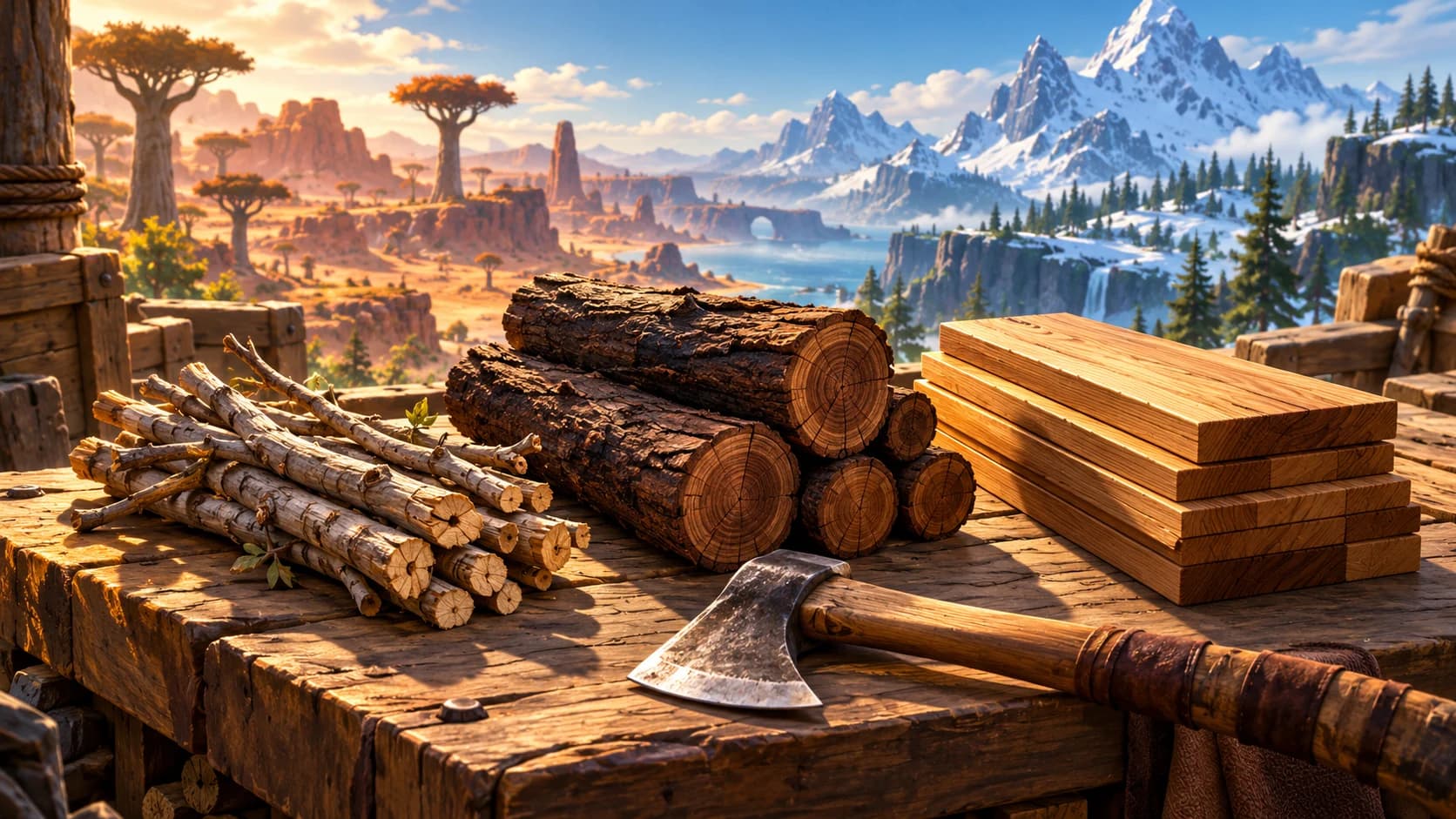
Cover: AI-generated editorial illustration of the three material forms, not a gameplay screenshot or a harvesting location.
Hardwood is not locked behind Sakurajima#
An October 21 Reddit discussion started with a returning player discovering Hardwood in the desert after previously traveling to Sakurajima for it. That is one player's useful discovery, not a new patch mechanic.
The English description for Hardwood identifies trees in harsh environments, including deserts, volcanic regions and snowy mountains. GameWith's Japanese gathering guide also lists desert, snow and Feybreak trees, with examples near 474, 685 in the desert and -100, 287 in the snow region. Use those as places to investigate on the interactive map, rather than assuming the next tree outside your starter base will work.
The practical check is simple: chop a tree and look for Hardwood in the pickup. If you are only getting ordinary Wood, a longer session at that same tree type is not solving your recipe. Choose an accessible area you already know instead of treating Sakurajima as a mandatory shopping trip.
For the figures below, we use the PalMods 1.0.3 game-data snapshot. The Hardwood item page and recipe pages let you inspect the underlying entries. These are recipe and production-data comparisons, not timed harvesting tests.
Start with the bill, because 25 and 100 are different jobs#
The first question is what you are actually building. These examples all consume Hardwood, but they do not justify the same supply setup.
In the table, bed means Large Pal Bed, shotgun means the standard Double-Barreled Shotgun, and boards means High Quality Wooden Boards.
| Project | Material bill |
|---|---|
| 1 bed | 5 Hardwood, 5 High Quality Cloth, 20 Nail, 20 Fiber |
| 1 shotgun | 25 Hardwood, 30 Refined Ingot, 7 Polymer |
| 20 beds | 100 Hardwood, 100 High Quality Cloth, 400 Nail, 400 Fiber |
| 1 Logging Site II | 100 Hardwood, 50 Stone, 20 Paldium Fragment, 5 Ancient Civilization Parts |
| 10 boards | 100 Hardwood, 100 Wood, 20 High Quality Cloth |
The twenty-bed row is our multiplication of the single-bed recipe. It makes the scale easier to see: the Hardwood entry cost of one Logging Site II equals the Hardwood in twenty beds. That is an investment in future supply, not an ingredient you should automatically buy before every smaller project.
The shotgun figure is the standard technology recipe. Schematic variants have separate material costs, so check the recipe you actually own before leaving base. Likewise, the ten-board row covers the boards themselves; it is not the complete cost of whatever building consumes them.
Buying a small stack can beat building a supply line#
The recorded Hardwood vendors include the Settlement Merchant, Duneshelter Merchant and Fisherman's Point Merchant, at 100 Gold per Hardwood before any discount. The snapshot also records a Wandering Merchant entry with a stock of 50, so that particular stock should not be mistaken for an unlimited order.
At the recorded price, the Hardwood for one standard shotgun is 2,500 Gold. The 100 needed for Logging Site II would be 10,000 Gold, before paying its other materials or technology points. Those sums only price the Hardwood portion.
Buying is especially sensible when you are five pieces short of finishing a bed or want to craft the gun and go back to exploring. A manual run makes more sense when you already have a suitable forest on your route and would rather keep the Gold. Neither choice needs a new base or a perfect Lumbering Pal.
Automation earns its space when the demand keeps returning. If the plan is ten boards today, more boards tomorrow, then beds for another outpost, buying each stack hides a recurring expense. That is the point where a staffed Logging Site II becomes a supply decision worth making.
Logging Site II has its own unlock and a slower work requirement#
Logging Site II is an Ancient Technology unlock at level 43, costing 3 points. Its build recipe is 100 Hardwood, 50 Stone, 20 Paldium Fragment and 5 Ancient Civilization Parts. A Pal with Lumbering works it; the building does not create output simply by existing.
The production records explain why an upgraded-looking building can still feel slow:
| Building and recorded output | Required work amount |
|---|---|
| Logging Site: Wood | 800 |
| Logging Site II: Hardwood | 8,000 |
That is ten times the recorded work requirement for the Hardwood output. It is not a promise that every real base takes exactly ten times as many seconds: worker suitability, work speed and time spent away from the task affect what you see. It does explain why comparing the two stockpiles without comparing their output is misleading.
If Hardwood is the bottleneck, check whether your Lumbering worker is actually spending time there. Building a second empty site does not supply the missing worker. The Palpedia helps compare work suitabilities, and our base automation guide covers the wider job-assignment problem.
The board recipe is why your old logging site still matters#
One High Quality Wooden Board requires 10 Hardwood, 10 Wood and 2 High Quality Cloth. Its recipe unlock is level 43 for 2 ordinary Technology Points, separate from Logging Site II's ancient unlock.
That creates two different level-43 decisions: unlock a material-processing recipe, and decide whether to invest in an automated source of one of its ingredients. Unlocking one does not pay for the other.
The Drafting Table makes a good worked example. It needs 10 boards, plus 20 Refined Ingot and 30 Charcoal. Making those boards from scratch adds 100 Hardwood, 100 Wood and 20 High Quality Cloth to the plan. If you build Logging Site II first, budget another 100 Hardwood for that building: 200 Hardwood across the two projects, not 100.
The resource planner is useful here because the hidden bill sits one recipe below the building you clicked. Keep the basic Wood source available, or deliberately gather that input another way. A chest overflowing with Hardwood cannot substitute for the ordinary Wood in the board recipe.
A supply plan that gets you back out of base#
- 1Choose the exact recipe
Check whether it wants Hardwood directly or High Quality Wooden Boards. Check schematic variants separately.
- 2Expand the board count
Multiply each board by 10 Hardwood, 10 Wood and 2 High Quality Cloth before counting the final building's other materials.
- 3Separate the immediate purchase from future production
Buy or chop a small shortfall. Reserve Logging Site II's 100 Hardwood only when recurring demand justifies it.
- 4Staff both material streams deliberately
Logging Site produces Wood; Logging Site II produces Hardwood. Keep access to both if boards are the goal.
If tonight's objective is a shotgun, make the shotgun. If it is a workshop expansion, budget the workshop and the supply building as two projects. Hardwood becomes much less frustrating once the stack in your chest has a named job.

Comments
Loading discussion...