The moment after the World Tree#
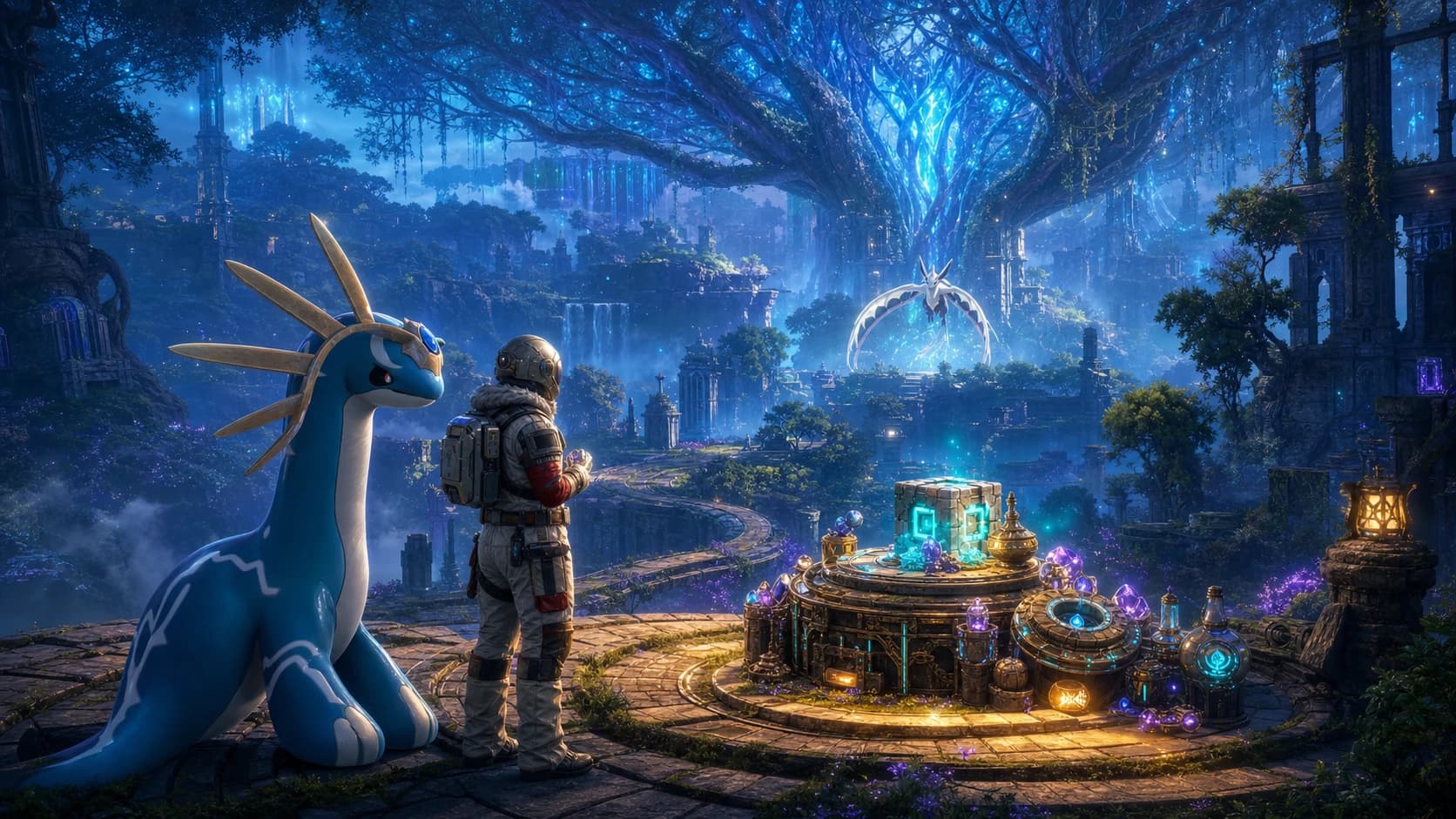
There is a specific moment this article is about. You have finished the story climax at the World Tree, the thing the official 1.0 release notes call central to Palworld's story and its greatest challenge. You fast travel home, open the map, and realize the game has quietly stopped telling you what to do next. What it offers instead is a pile of systems: Awakening, Mutation, soul ranks, condensation, selectable Hard Mode tower rematches, reworked base raids, Arena rewards, and Palpedia completion targets.
The easy diagnosis is "the endgame is grindy," and that is not wrong so much as incomplete. The deeper question is what each round of grinding buys you. Long loops are fine when each lap changes your options. Palworld 1.0 often changes the size of the same option.
So before evaluating anything, here is what 1.0 actually added, as documented.
What Palworld 1.0 actually gives you#
The official notes say 1.0 adds Sunreach and 72 Pals, raises the player level cap from 65 to 80, and introduces Awakening and Mutation. The current PalMods World Tree guide describes the Tree itself not as a final dungeon but as a separate level 70-80 endgame map, with its own unlock route through Panthalus and the Echoing Flute. The same official notes also cut maximum-rank condensation from 116 total Pals to 48, add mutation and specialized cakes, add new passives, and rework Partner Skills. On top of all that sit selectable Tower Hard Mode rematches with a five-minute limit, and base raids reworked into successive waves with rewards at the end.
That is a real post-story ladder, not filler. Here is its shape, with documented mechanics in the first three columns and analysis confined to the last.
| Endgame layer | Documented activity | Immediate reward | Where it can flatten (analysis) |
|---|---|---|---|
| World Tree farming | Enter the level 70-80 Tree, preserve resources, gather Paloxite, Holy Water, Radiant Gems, and Relics | Materials for every other layer | Every other layer routes back here |
| Awakening | Craft element-matched Awakening Crystals | A one-time power layer per Pal | Same fights, bigger numbers |
| Breeding and Mutation | Chase passives and mutations with specialized cakes | A stronger or stranger Pal | Payout measured mostly in combat stats |
| Condensation and souls | Feed 48 copies for max rank, climb 20 soul ranks | Steady stat growth | Pure accumulation |
| Tower Hard Mode | Selectable rematches under a five-minute limit | Clear flags and rewards | Each retry can be gated by more farming |
| Base raids | Defend successive waves, collect rewards after | Loot and base-building pressure | Optional enough to never engage |
| Collection | Palpedia, World Tree species, Arena rewards | Checklist completion | A checklist ends exactly once |
The loop is not just long. It is narrow.#
Walk through one concrete project: Awakening a favorite Pal. The current PalMods Awakening Hub, which is client-verified against build 24088745, records that one element-matched Awakening Crystal costs 50 matching Radiant Gems plus 10 World Tree Holy Water, with a work amount of 30,000, a serious production job in its own right. The client data does not expose a reliable per-Pal crystal total, so there is no honest reason to invent one, but the recipe alone tells you the shape of the shopping list.
Now the shopping trip. Radiant Gems are hunted element-matched, so your target Pal's element decides where you farm. Holy Water comes from the Tree and its surrounding systems. And inside the Tree, per the World Tree guide, nearby resources vanish as you gather unless you carry World Tree Holy Water or run one of seven World Tree passives. The resource you are farming is also the resource that protects the farming. Add Paloxite and Ancient Civilization Relic processing for the other recipes and you have the real 1.0 loop: enter the Tree, keep your nodes from disappearing, haul out gems, water, Paloxite, and Relics, craft, strengthen, and finally go hit the encounter that motivated the trip. Then, usually, go back.
To be fair to the current patch, the v1.0.3 notes made Holy Water lighter and longer-lasting, and added supply through World Tree expeditions, World Tree fishing, the Large Fishing Pond, increased drops from World Tree Pals, and increased Teafant Spring yield. The launch-week choke point is genuinely softer now, and any description of Holy Water scarcity from before that patch is describing an older game.
Here is the narrowness. Awakening is a one-time layer, distinct from the 20 soul ranks and from full condensation, which the official notes mercifully reduced from 116 Pals to 48. Three separate investment systems, and all three run on the same verbs: farm materials, apply them to a Pal, watch a number rise, return to the same map for more materials. The 1.0 rework smoothed this loop, with fewer condensation bodies, new cakes, and reworked Partner Skills, but smoothing is not the same as widening. Nearly every road leads back through the Tree, and nearly every reward is denominated in combat power. That is why "grindy" undersells the complaint. Long loops are fine when each lap changes your options. These laps mostly change your damage.
Three players can reach three different conclusions#
Palworld's endgame serves three different player goals, which is exactly why the same systems can feel rich to one person and hollow to another. The endgame is not one activity, and it should not be judged by one player's preferred reward. These archetypes are not mutually exclusive, but they expose the fault lines.
| Player | What feels rewarding | What stalls | Practical next step |
|---|---|---|---|
| Optimizer | The puzzle itself: passives, condensation, souls, Awakening, mutation cakes, and build testing | Few new arenas to test builds in beyond the same bosses | Pick one target fight, plan lines in the breeding calculator, and Awaken for that fight only |
| Completionist | Checklists: Palpedia, World Tree species, tower rematch rewards, Arena rewards, and rare items | Some entries sit behind heavy farming, and lists end | Order the lists by joy per entry, not by percentage remaining |
| Adventure-driven | Sunreach, the Tree as a place, bases, emergent chaos, and the story itself | Post-story content is mostly preparation, not discovery | Start a fresh run, build a base-first project, or make a clean stop after the climax |
Note the last cell. Stopping after the World Tree is a next step, not a failure, because for this player it can be the correct conclusion. A survival game with a story climax has a place where the story is over.
The best defense of the current endgame#
The strongest counterargument deserves stating plainly. Optional pinnacle content has always been allowed to demand long preparation. That is what pinnacle means, and the five-minute limit on Hard Mode rematches is effectively a promise that the fight is tuned for a prepared team. Demanding long preparation for an optional wall is a design tradition, not automatically a defect.
For optimizers, the loop is not an obstacle between them and the game. It is the game. Breeding lines, passive hunting, and build testing are the intended hobby, and the 1.0 changes, from cheaper condensation to reworked Partner Skills, read like direct investment in that hobby. Telling those players their fun is a treadmill would be the wrong conclusion.
And a game that ends is not a broken game. Not everything needs a forever loop, and "I finished it and moved on" is a healthy sentence, not a review score.
What would make the loop feel better#
Start with what ships today, because you can act on it this session.
- Choose one project. The pile feels daunting because it is presented all at once. Pick a single goal, such as one Awakened Pal, one tower, one Palpedia region, or one base project, and treat everything else as background.
- Stop at good-enough passives. Perfect four-passive lines are an optimizer's hobby, not an entry fee. A "good enough to win" Pal keeps the adventure moving, and plenty of players clear the story path without ever touching a breeding pen.
- Try one Hard Mode tower. The official notes make rematches selectable, tie the access flag to the Azure Covenant Tower, and cap attempts at five minutes. Tower Hard Mode is a per-fight choice, not the save-wide Hard setting. The PalMods Hard Mode tower guide covers preparation, so this article will not duplicate it.
- Use selective World Settings. The PalMods World Settings guide recommends changing the specific friction that blocks your goal, such as XP or incubation pacing, rather than flattening every resource rate. There is no single correct preset, only the one that removes your particular wall.
- Invent a challenge run. These are house rules, not official modes: no breeding, captures allowed only in one named area, a monotype team, a base-first project, or a time-boxed speedrun. A base-first run pairs well with the reworked raids, where waves pay rewards, biome changes the enemy types, defense structures and Work Pals genuinely matter, and a Negotiator can cancel an incoming raid for gold. The base and raid guide has the details.
Then the short design wishlist, offered as analysis rather than expectation. Rewards that unlock decisions would help most. An Awakening that changed how a Pal plays, rather than only how hard it hits, would make every crystal a fork in the road. Discovery inside the farm would help too. The Tree is a genuinely evocative place, and its routes would feel different if they could surprise you. And v1.0.3's Holy Water spread, with one goal fed by expeditions, fishing, ponds, drops, and springs, is the right template: the more kinds of play that feed a single requirement, the less any one of them feels like the only road.
A better endgame test#
Here is the stopping rule I would hand any player standing at the base of the post-story ladder. After each investment, ask what it just unlocked: a decision, a discovery, or a story beat. If the honest answer is only "the next farm is faster," stop, or change the goal.
This test is not anti-grind. An optimizer answers "a decision" constantly, because build testing is nothing but decisions, and the test tells them to keep going. A completionist answers "a discovery" until the checklist thins out. An adventure-driven player may find the answers run dry one evening in the Tree, and that is information, not failure. The test does not tell you the endgame is bad. It tells you when the endgame has stopped being yours.
Where that leaves the title#
Palworld 1.0's endgame problem is not just the grind, because the hours themselves were never the issue. Games we love ask for more. The problem is that so many of 1.0's investment systems pay out in the same currency, through the same map, toward the same fights, so the ladder is tall but the view rarely changes. The Tree is a real place, Hard Mode is a real test, and breeding is a real hobby. Whether that adds up to your endgame depends on which of the three players you are, and the game, to its credit and its cost, leaves that entirely up to you.



Comments
Loading discussion...